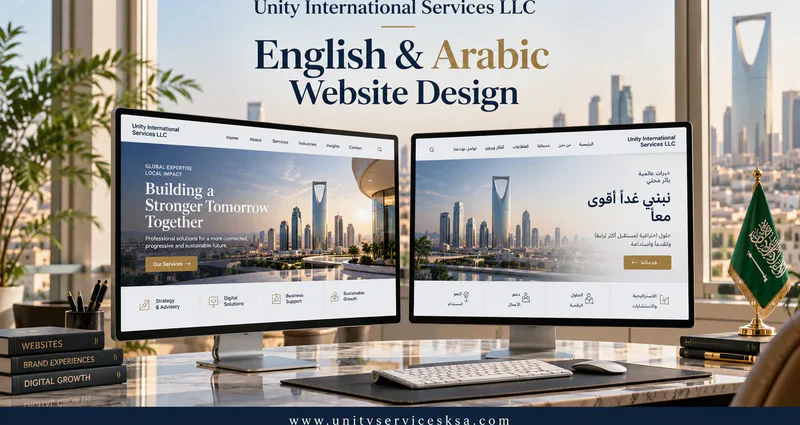
Your website is often the first place a potential customer learns about your business. Before making a call, requesting a quotation, or visiting your office, people want to understand what you offer and why they should choose you. A professional website makes that decision easier by presenting your services clearly and providing a straightforward way to contact your team.
For businesses searching for the best web development company in Saudi Arabia, Unity International Services LLC offers website development, business software, and maintenance services designed around practical business requirements.
Based in Makkah, Unity helps businesses plan a digital presence that supports their brand, communicates their capabilities, and creates opportunities for customer enquiries. From corporate websites to e-commerce platforms and custom applications, the aim is to build a website that serves a clear business purpose.
About Unity International Services LLC
Unity International Services LLC provides technology products and digital services for businesses in Saudi Arabia. Its published website service categories include corporate websites, online stores, custom web applications, business software, integrations, and ongoing maintenance.
This range is useful for organizations that need more than a company profile page. A business may initially require a website to introduce its services, then later need online ordering, appointment requests, customer accounts, or connections with internal software.
Unity’s offering brings these requirements into one project discussion, helping customers consider both their immediate needs and future development plans.
Why Choose Unity for Web Development in Saudi Arabia?
The best website development partner for your business should understand your objectives, explain the proposed solution clearly, and provide a manageable path from planning to launch.
Unity’s combination of website services, software offerings, and technical support makes it a company worth considering for businesses seeking this approach.
Websites Planned Around Business Goals
A website should support the way your company operates.
For a construction company, the priority may be presenting completed projects and generating quotation requests. For a retailer, it may be organizing products and supporting online orders. For a professional service provider, it may be explaining expertise and encouraging consultation bookings.
Defining these goals early helps determine the website’s structure, content, and functionality. Every important page should help visitors understand the business or complete a useful action.
Professional Design and Clear Communication
Good design helps customers navigate information comfortably. Consistent colors, readable typography, authentic images, and well-organized layouts create a professional impression.
However, presentation works best when supported by clear content. Visitors should quickly understand your services, the customers you serve, and how to reach your team.
A successful website combines visual quality with useful information rather than relying on appearance alone.
Responsive Experiences Across Devices
Customers should be able to browse your website comfortably on smartphones, tablets, and desktop computers.
Responsive website development adjusts layouts to different screen sizes. It also considers practical details such as readable text, accessible navigation, appropriately sized buttons, and forms that are easy to complete.
These details help visitors move from browsing to enquiry without unnecessary difficulty.
Support for Future Growth
Business requirements change. A company profile website may eventually need a product catalog, booking system, customer portal, or additional language.
Planning for likely changes helps businesses choose a suitable platform and avoid unnecessary redevelopment. The website should provide a foundation that can be maintained and expanded as needs evolve.
Website Development Services
Unity’s published service categories cover a broad range of website and application requirements. The final features, deliverables, and support arrangements should be defined in the individual project proposal.
Corporate Website Development
A corporate website presents the company’s identity, services, experience, and contact information in one organized platform.
Typical sections include:
- Company overview and background
- Services and industries served
- Project portfolios
- Product or solution information
- Careers and recruitment
- Contact and quotation forms
The strongest corporate websites use original content and relevant project examples to help customers assess the business.
E-Commerce Website Development
An online store needs to make products easy to discover, compare, and order.
Depending on the project scope, an e-commerce website may include product categories, specifications, variations, customer accounts, shopping carts, payment integration, and order notifications.
The development process should also consider how staff will update products, manage orders, and answer customer questions. A store works best when the customer experience and internal workflow are planned together.
Industry-Specific Websites
Different industries require different information and customer journeys.
A restaurant website may prioritize menus and reservations. A hotel may need accommodation information and booking enquiries. A school may need admissions guidance and academic information. A supplier may need technical specifications and quotation requests.
Industry-focused planning helps make the website useful to the people most likely to become customers.
Landing Pages
A landing page supports a specific campaign, product, or service.
Its content should explain the offer, answer key questions, and guide visitors toward one primary action, such as requesting a quotation or booking a demonstration.
A focused landing page can also make campaign measurement easier because the intended customer action is clearly defined.
Custom Web Applications
Some businesses need functionality beyond a standard website.
Custom applications can support customer portals, internal dashboards, approval workflows, booking processes, or other business activities. These projects require careful requirements gathering, access planning, and testing.
The scope should explain what the application will do, who will use it, and how it will connect with existing processes.
Technology: Choosing the Right Platform
Technology should be selected according to the project’s purpose, maintenance requirements, and budget.
Unity’s website lists platform-related services including WordPress, WooCommerce, Shopify, Webflow, and Wix. Each platform suits different requirements, so the choice should follow a discussion of the business’s needs.
A content-focused corporate website may benefit from a straightforward content management system. An online store needs tools suited to its catalog and ordering process. A custom application may require a more specialized technical foundation.
Five considerations should guide the decision:
| Consideration | Why it matters |
|---|---|
| Content management | Staff need a practical way to update pages and information. |
| Performance | Customers need pages that load efficiently. |
| Security | Access, updates, and data handling need appropriate controls. |
| Integration | Required systems must exchange information reliably. |
| Maintenance | The platform should remain manageable after launch. |
A suitable technology choice balances these needs rather than adding complexity without a clear benefit.
Arabic and English Website Development
Businesses serving different customer groups may need both Arabic and English content.
A bilingual website requires more than translated text. Arabic pages need appropriate right-to-left layouts, readable typography, and carefully reviewed navigation. Contact forms, buttons, and important customer journeys should work consistently in both languages.
Language requirements should be agreed early so that content preparation, design, and testing are included in the project schedule.
How a Professional Website Project Works
Step 1: Define the Objective
Identify the audience and the action the website should encourage. This could be an enquiry, purchase, booking, application, or request for information.
Clear objectives help keep the project focused.
Step 2: Agree on the Scope
Document the required pages, languages, features, integrations, and content responsibilities.
A written scope should also explain deliverables, review stages, and what will count as successful completion.
Step 3: Plan Content and Navigation
Organize information so that visitors can find answers naturally. Prepare service descriptions, company information, authentic images, and relevant supporting material.
Content should explain the business clearly and address customer questions.
Step 4: Design and Develop
Create responsive layouts around the approved structure, then build the required functionality.
Reviewing key pages and workflows during development helps identify issues before the final launch stage.
Step 5: Test the Website
Testing should cover navigation, forms, mobile layouts, language switching, and any ordering or booking processes.
It should also confirm that enquiries and notifications reach the correct people.
Step 6: Launch and Hand Over
Prepare domain settings, hosting, backups, and administrative access. Provide the information staff need to manage the website and request support.
A clear handover makes ongoing ownership easier for the business.
SEO-Friendly Website Development
A professionally developed website should give search engines and customers a clear understanding of its content.
Useful foundations include descriptive page titles, logical headings, relevant internal links, optimized images, and accessible navigation. Important service pages should explain what the company offers, who the service is for, and how customers can take the next step.
For local business visibility, company names, contact details, and location information should remain consistent.
Content quality also matters. Helpful service explanations, practical articles, and accurate product information give visitors reasons to explore the website.
SEO requires continuing attention. A sound website foundation supports this work, while results depend on content, competition, demand, and ongoing improvements.
Website Maintenance and Technical Support
Launching a website is the beginning of its operational life. Content changes, platform updates, hosting requirements, and new business needs require ongoing attention.
Unity’s published maintenance categories include bug fixing, security updates, backups, hosting management, website migration, performance monitoring, and content updates.
Before starting a project, customers should agree on:
- The maintenance services included
- How support requests will be submitted
- Expected response arrangements
- Responsibility for backups and updates
- Charges for additional development
Clear support terms help businesses understand how their website will be maintained after launch.
Security and Performance
Security should be considered throughout development and maintenance.
Appropriate measures may include HTTPS, controlled administrative access, software updates, backups, and validation of submitted information. The exact measures depend on the platform and the type of data being handled.
Performance also requires ongoing attention. Large images, unnecessary scripts, and inefficient page structures can make browsing slower. Reviewing these factors helps improve the experience across devices and connection speeds.
Both security and performance benefit from regular maintenance and clear responsibility.
Frequently Asked Questions
Why consider Unity International Services LLC for website development?
Unity offers website development alongside business software and maintenance services. Businesses can assess its suitability by discussing their requirements, reviewing relevant work, and agreeing on a clear proposal.
Can Unity develop a corporate website or online store?
Both corporate websites and e-commerce appear among Unity’s published service categories. The required features and deliverables should be confirmed for the individual project.
Can a website include Arabic and English?
Bilingual functionality can be included in the project scope. Translation, Arabic layouts, navigation, and testing should be planned together.
How much does website development cost?
The cost depends on design requirements, pages, languages, functionality, integrations, and support coverage. A detailed quotation should identify what is included.
How long does development take?
The schedule depends on project complexity, content readiness, integrations, and review times. A realistic timeline should be agreed after the scope is defined.
Can an existing website be redesigned?
A redesign can address presentation, navigation, content, and functionality. Existing pages and search visibility should be reviewed before structural changes are made.
Is support available after launch?
Unity lists website maintenance and technical support services. Coverage, response arrangements, and costs should be confirmed in the service agreement.
Start Your Website Project With Unity
A professional website should make your business easier to understand and easier to contact. Whether you need a corporate website, online store, or custom application, start by defining the customer experience and business results you want to achieve.
Unity International Services LLC offers a range of website and software services for businesses considering a development partner in Saudi Arabia.
Location: Al Shoqiyah, Makkah, Saudi Arabia
Phone: +966 530651576